How to Innovate Your Innovation


Overuse of the term Innovation has led to its meaning becoming 'fuzzy' (Innovation pun intended).
What actually is Innovation, and how do you achieve it?
If you spot check five of your favourite organisations, you will likely find the word in their strategy – because Innovation is critical for business survival. Outstanding organisations are outstanding innovators, per this IBM report.
If you’re not innovating, you’re not surviving – See: Kodak, Blockbuster, Nokia…
While it is true that there is a lot of innovation happening, it’s also true that there’s a lot of innovation not happening, with some Common Innovation Problems:
🚫 Issue 1: Assumption that innovation must be disruptive, as with the iPhone or GenAI.
Innovation can be any value-adding capability within a new or existing product or service. Innovation generally includes:
- Product
- Process
- Service
- Business Model
- Operating Model
- Organisational
🚫 Issue 2: Innovation must take place in the end product or service
You can innovate a product or service without changing the final output.
Ford innovated the moving assembly line in 1910s, reducing costs, increasing output volumes and increasing product accessibility.
🚫 Issue 3: Telling people to “be innovative” ≠ innovation
You need innovation structure – telling people to 'be innovative' and to innovate is not enough..
How Do You Change This?
You need at least 3 things: Innovation Portfolio, Innovation Culture, and Innovation Freedom.
If you don’t have any, Blue Sky Innovation is fine – but your Innovation KPIs are going to be very red unless you have an accompanying portfolio and/or strategy.
1. Innovation Portfolio & Strategy ♟️
Define an Innovation Portfolio and commit to a set of innovation strategies and principles. Link it to your organisational strategy too.
 Gary P. Pisano
👆 Gary Pisano’s aptly named article outlines exactly why you need an innovation strategy
⚖️ Ambidexterity
Not all innovations are ‘new’.
You can explore or exploit innovation within existing or new products and technologies.
The process of exploring new innovation opportunities and exploiting existing ones is called ambidexterity. The balance is up to you – but lack of ambidexterity reduces innovation clarity and focus.
🎯 Ambition
What is your innovation ambition?
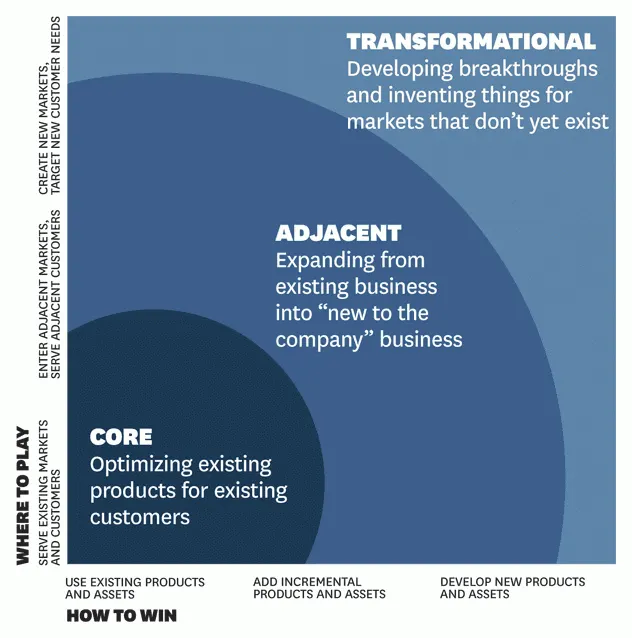
Everyone aims for disruptive transformational innovation – but what are you doing with Core and Adjacent innovation? Are you technology push or consumer pull focused?
Map some of your ongoing projects on the diagram below and see where they land.
If you’re neglecting core, you’re also neglecting your existing customers and user base.
💪 Innovate to Your Strengths
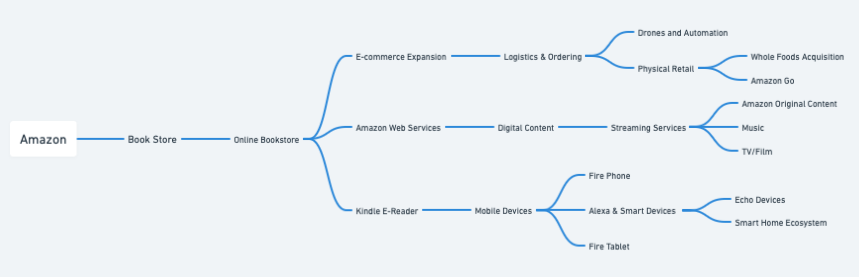
Amazon’s transition from bookseller to cloud computing may lead you to believe mega organisations innovate at random – but it is not random.
It’s actually more difficult for large organisations to innovate due to scale complexities – so effort must be placed in leveraging core strengths.
The diagram below maps Amazon’s innovation, showing how they pivot from one strength to another - eventually innovation from crossovers of previous organisational strengths.
2. Culture
Innovation must be cultivated – not ordered.
Given that innovations must start as an idea, fuelled by creativity – and Gerard Gaynor correctly advises that creativity isn’t limited to 9-5 – you need to create an innovation culture that politely extends out of hours.
Alexander Fleming and Isaac Newton are two inventors we know had their breakthroughs away from the office.
💡 Creativity & Ideation
It was 3M, not Google, who pioneered Bottom-Up Innovation (BUI).
Art Fry commercialised the Post-it Note through their entrepreneurship-supporting 'bootlegging' incentives – aka: “Spend 15–20% of your time on projects you believe in.”
While you may have such practices in place – without the aforementioned portfolio and strategy, what are people aiming for?
Freedom is great, but without control it’s chaos.
💭 Psychological Safety
I use this concept in all of my blogs, but it’s always relevant.
If people don’t feel secure enough to challenge, question, or ideate – your innovation will stagnate, along with the people.
Collaboration is a key driver of innovation – for which you will need psychological safety.
🔍 Innovate Anything
There’s often too much focus on innovating the end product or service to a radical or transformational level.
Raising awareness that pretty much anything can be innovated to any degree and be considered innovation will increase the innovative landscape.
90% of people who have ever worked will have an idea of how to innovate an existing process or procedure.
They probably just don’t know how to frame it – and psychological safety issues may reduce people’s ability to challenge the norm.
Disguise it as innovation…

3. Innovative Freedom
Innovation requires freedom – and I don’t just mean 15-20% of time. It requires true freedom, away from pretty much everything.
I would argue that great creation and innovation doesn’t take place at work
🏕️ Innovate in Isolation
SkunkWorks was formally moved away from Lockheed’s HQ – not only for classified project focus, but to separate from the organisational norms.

A PESTEL analysis of your innovation landscape can help identify those norms.
Samsung physically moved their R&D closer to Seoul with additional benefits local talent capture. Don’t innovate in a vacuum though - unless you are Dyson, Shark or Hoover!
🚧 Creative Barriers
You need creative barriers to steer ideation – but not too many.
Organisational culture, politics, bureaucracy, even the physical working environment can restrict creativity and innovation.
🎨 Understand Your Creative Types
Everyone possesses creativity – but each in different ways, styles, and schools of thought.
Creativity can be trained and influenced – but it cannot be forced.
You must understand the creativity types within the team – identify strengths and weaknesses – and act to continuously enable and drive those creative types efficiently.
📊 Don’t Metricise It
Despite my love for data and analytics – I don’t agree with metricising innovation.
Numerical innovation incentives can promote dishonest behaviour to hit targets (Ibbotson & Darsø, 2008).
Convert innovation objectives to meaningful goals – e.g., “Let’s make our products run faster.” Or “Lets reduce our production cycle”
This will reduce creative barriers and increase alignment, while setting a goal and expectation.
🤔 Create In Your Own Time
Creativity is the foundation of innovation – and creativity doesn’t operate only 9-5.
Although enforcing creativity and innovation in people’s spare time is not advised – I am not entirely against it. But it’s more of an empowerment activity rather than homework setting.
"Be alone—that is the secret of invention: be alone, that is when ideas are born" - Nikola Tesla, 1896
We can’t control when people are creative. But we can encourage open mindedness, to draw inspiration from everyday experiences, and normalise having ideas outside of the office. Note it down and bring it next time you’re in work.
Or keep a notepad next to your bed…

Do you need to start innovating your innovation?